
Blog

Read our latest articles for tips, tricks, advice and news about research techniques and solutions.

CloudResearch blog - online research articles and insights
AI and the Future of Survey Fraud
Aaron Moss, PhD

AI and the Future of Survey Fraud

AI agents can now complete surveys, passing 99.8% of attention checks. Part 2 of the data quality crisis explores AI as both threat and tool.

Read More

The Singularity Is Not an Event
Jonathan Robinson, PhD

The Singularity Is Not an Event

The Singularity isn't a single moment — it's a rolling frontier crossing one domain at a time. Chess, Go, protein folding. Survey research is next.

Read More

The Worst-Kept Secret in Market Research
Jonathan Robinson, PhD

The Worst-Kept Secret in Market Research

Panel companies have known about the data quality problem for years — and kept laughing about it. CloudResearch explains why, and what accountability actually looks like.

Read More

The Bots Have Arrived
Jonathan Robinson, PhD

The Bots Have Arrived

CloudResearch detected autonomous AI agents attempting to complete surveys — less than 0.1% of traffic, but a clear signal. Here's what we're seeing and what it means.

Read More

Sunsetting the MTurk Toolkit
Jonathan Robinson, PhD

Sunsetting the MTurk Toolkit

CloudResearch is retiring the MTurk Toolkit by end of 2026. Learn why we're sunsetting the product, what it meant to us, and how Connect, Engage, and Sentry are the future of high-quality survey research.

Read More

Bots, Cyborgs, Zombies, and Humans
Jonathan Robinson, PhD

Bots, Cyborgs, Zombies, and Humans

Not every data quality problem in survey research is a bot problem. Learn the four-part taxonomy — Bots, Cyborgs, Zombies, and Humans — and why the distinction matters.

Read More

Coming Soon: Panel Patrol
CloudResearch

Coming Soon: Panel Patrol

CloudResearch is coming to a kids channel near you with Panel Patrol — a new show about defending surveys from bots. (Okay, not really… but data quality matters.)

Read More

When Science and Nature Knock on Your Door
Jonathan Robinson, PhD

When Science and Nature Knock on Your Door

A reflection on the moment when scientific researchers shift from submitting papers and navigating peer review to being recognized as authorities—when leading journals and science journalists come seeking your expertise.

Read More
Trust What You See
Jonathan Robinson, PhD

Trust What You See

Without a ground truth, you're not doing quality control — you're guessing. Learn why Sentry is the only data quality solution with face validity, and why evidence should always win over authority.

Read More

The Machine That Saw Me
Jonathan Robinson, PhD

The Machine That Saw Me

A ChatGPT conversation about figure skating turned into an unexpected mirror, revealing blind spots about how facts alone don't move people.


Read More

Staying Ahead of the Curve: The Existential Threat of AI Agents to Survey Research
CloudResearch

Staying Ahead of the Curve: The Existential Threat of AI Agents to Survey Research

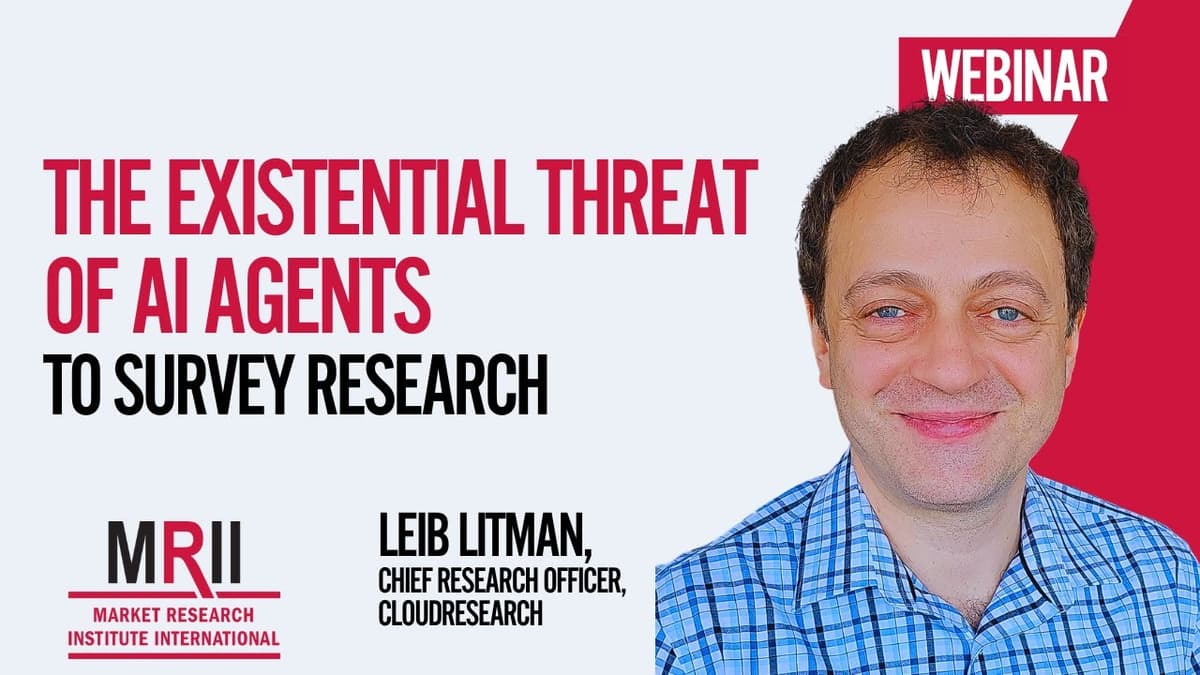
On December 17th, 2025, CloudResearch hosted an MRII webinar in response to a paper in the Proceedings of the National Academy of Sciences (PNAS) reporting that AI agents passed 99.8% of attention checks, examining the implications for survey research and how CloudResearch is staying ahead of this emerging threat with purpose-built data integrity solutions.

Read More

When AI Dreams: Hidden Risks of LLMs
Jonathan Robinson, PhD

When AI Dreams: Hidden Risks of LLMs

As LLMs show hidden and deceptive behavior, new risks are emerging. Learn how CloudResearch is building defensive AI to protect data quality and research integrity.

Read More

OpenAI's 28-Day Study on Connect
Aaron Moss, PhD

OpenAI's 28-Day Study on Connect

OpenAI and MIT partnered with CloudResearch Connect to conduct a longitudinal study examining how regular ChatGPT use affects emotional well-being. Learn why OpenAI chose CloudResearch for this ambitious 28-day research project involving 981 participants and over 32,000 surveys.

Read More

A City Divided between Hope and Fear
Reuben Paris

A City Divided between Hope and Fear

Beacon Research partnered with CloudResearch to survey over 600 New York City voters using the AI-powered Engage platform, uncovering an election driven by two ...

Read More

Changes to Connect Pricing
Charles Jamerlan

Changes to Connect Pricing

Starting January 1, 2025, the standard service fee on Connect increased to 40%. This adjustment supports our ongoing investment in delivering the industry's most advanced research platform, while maintaining our steadfast commitment to academic and non-profit research by keeping their service fee at 25%

Read More

Sympathy for a Killer
Zohn Rosen, PhD

Sympathy for a Killer

CloudResearch conducted a study to better understand the people who support Luigi Mangione's decision to murder UnitedHealthcare CEO Brian Thompson

Read More

CloudResearch is Now SOC2 Compliant!
Charles Jamerlan

CloudResearch is Now SOC2 Compliant!

Discover how SOC2 compliance, alongside CloudResearch's commitment to security through certifications and best practices, ensures data security and customer trust in the digital age.

Read More

Time to Move Your Mind and Improve Your Mood
Yrjö Rinne & Michiel Spapé

Time to Move Your Mind and Improve Your Mood

A recent time perception study examines the relationship between activity and mental time and explores the potential link to detecting depression and inspiring potential new treatments. Learn more from CloudResearch grant winners Yrjö Rinne & Michiel Spapé.

Read More

How Can You Get High-Quality Data from Amazon's Mechanical Turk? With CloudResearch's Approved Participants!
Aaron Moss, PhD

How Can You Get High-Quality Data from Amazon's Mechanical Turk? With CloudResearch's Approved Participants!

Humans have used information about other people's reputations for tens of thousands if not hundreds of thousands of years. Given people's fluency with tracking others' reputations it is not surprising that many tech platforms rely on reputation systems to help regulate transactions between strangers (think Airbnb reviews). For behavioral researchers who use Amazon Mechanical Turk (MTurk), the story is no different: many researchers rely on reputation metrics when sampling participants.

Read More
Research on The Self-Regulation of Face-Touching: Running a Remote Observational Experiment
Lucas Keller & Marie-Claire Kabengele

Research on The Self-Regulation of Face-Touching: Running a Remote Observational Experiment

In March 2020, health authorities around the globe were quick to release recommendations to avoid COVID-19 infections. As many things about COVID-19 were uncertain, several recommendations were based on research on other infectious diseases, some of which are transmitted via smear infections. One of these recommendations that remains on the CDC's website to this date was to "avoid touching your eyes, nose, and mouth with unwashed hands."

Read More
Juneteenth is a Federal Holiday. But What Do People Know About it?
Aaron Moss, PhD

Juneteenth is a Federal Holiday. But What Do People Know About it?

Despite widespread media attention in recent years, polling conducted by CloudResearch in June of 2021 and again in 2022 shows that most people know little about the holiday Juneteenth. Only about half of the US population, for example, knows that Juneteenth marks the end of slavery. And only one fifth of people have plans to celebrate the holiday this year.

Read More
The Trouble with Maintaining Data Quality in Online Research
CloudResearch

The Trouble with Maintaining Data Quality in Online Research

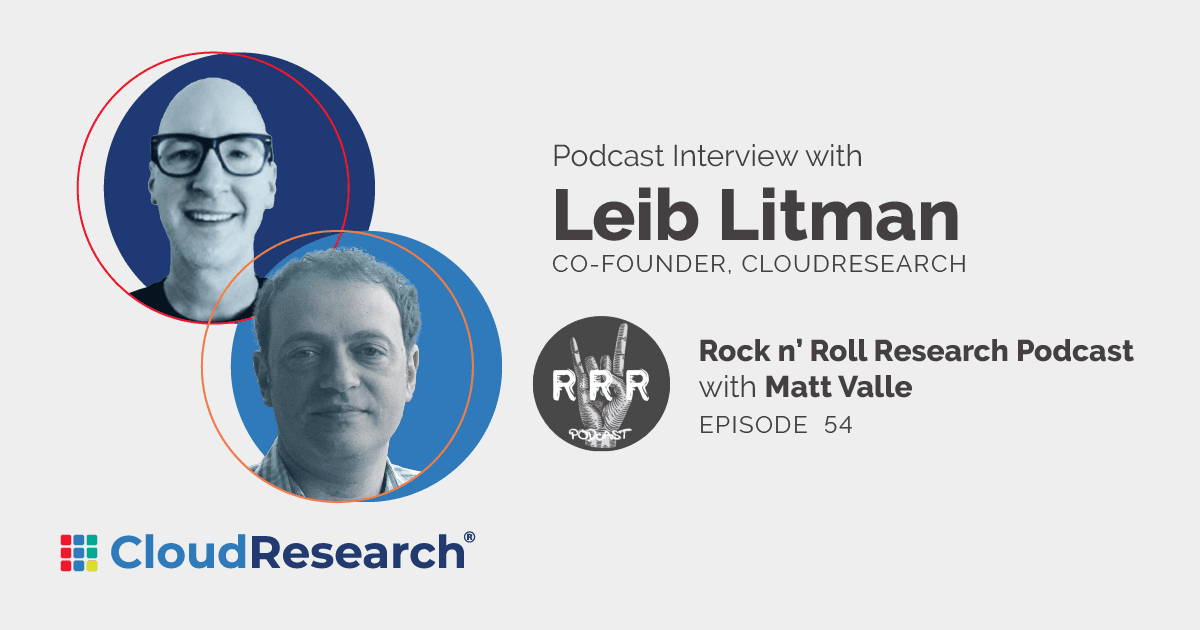
When it comes to data quality in market research, our team at CloudResearch thrives on creating solutions and leading important conversations. What better way to “talk shop” than joining experienced UX Researcher and industry thought leader, Matt Valle on his...

Read More
Do Parenthood and Parental Care Motives Lead To Increased Religiosity?
Nicholas Kerry, PhD

Do Parenthood and Parental Care Motives Lead To Increased Religiosity?

Psychologists have spent a lot of time studying how parenting affects children. Attachment theory, for example, may be one of the widest studied topics in all of psychology. But despite a longstanding focus on parenting and children, relatively little time has been spent thinking about how parenthood affects parents themselves. This is in many ways surprising.

Read More
How to Conduct an Online Pricing Survey
Aaron Moss, PhD

How to Conduct an Online Pricing Survey

How much is your audience willing to pay for your product or service? Brands often struggle to answer this crucial question; online pricing surveys offer a fast, efficient solution.

Read More
Pay Justice in a Newly Developing Economy
Zohn Rosen, PhD

Pay Justice in a Newly Developing Economy

In 2020, the Covid-19 pandemic initiated an unprecedented shift in the American workforce. In a matter of weeks a significant portion of the labor force shifted to working online, a change likely to remain in place for the foreseeable future. Although many of these workers are continuing to perform their pre-pandemic jobs from home, an ever-expanding number are participants in the gig-economy.

Read More
How to Award a Bonus to MTurk Workers Using CloudResearch
Aaron Moss, PhD

How to Award a Bonus to MTurk Workers Using CloudResearch

One feature of Mechanical Turk is the ability of researchers to give workers bonus payments. Bonuses may be issued for various reasons such as exemplary performance on a task, answering extra questions in a study, or as a reward for...

Read More
Understanding Turkers: How Do Gig Economy Workers Use Amazon's Mechanical Turk?
Aaron Moss, PhD

Understanding Turkers: How Do Gig Economy Workers Use Amazon's Mechanical Turk?

By now, most people have heard of the gig economy and have some idea of how it works. In the gig economy, people perform short-term jobs or tasks to earn money. Gig economy jobs are considered independent or contract work, meaning people who work in the gig economy often trade the benefits and stability of traditional employment for the freedom and flexibility to decide when and how much they work.

Read More
How Do Most MTurk Workers Work?
Aaron Moss, PhD

How Do Most MTurk Workers Work?

A persistent cause of concern for researchers who conduct studies online is understanding what participants might be doing while completing their study. When participants are outside the lab, they cannot be observed and distracting aspects of the environment cannot be controlled by the research team. As a result, researchers are left to wonder: how much attention are participants giving my survey?

Read More
How to Easily Run a Pilot Study on CloudResearch
Aaron Moss, PhD

How to Easily Run a Pilot Study on CloudResearch

Last month, we published a blog titled, “Five Things You Should Not Be Doing in Online Data Collection.” Among the things we identified that you should not be doing was launching your study without piloting it first. As a way...

Read More
Transfer Funds From One CloudResearch User to Another
Aaron Moss, PhD

Transfer Funds From One CloudResearch User to Another

Academic research is a collaborative endeavor. Faculty members work with post-docs, grad students, and undergrads. Sometimes one lab collaborates with another. During the course of such work, resources sometimes need to be shared or redistributed. At CloudResearch, we have sought...

Read More
Spread Your Data Collection Over Days or Weeks With MicroBatch
Aaron Moss, PhD

Spread Your Data Collection Over Days or Weeks With MicroBatch

One reason Amazon Mechanical Turk has become so popular among researchers is the speed with which data can be collected. Compared to more traditional research methods — lab-based experiments, field studies, ethnographic interviews, etc. — MTurk is exceptionally fast, making...

Read More
Revisiting CloudResearch's Survey Group Feature
Aaron Moss, PhD

Revisiting CloudResearch's Survey Group Feature

What Is a Survey Group? Survey Groups are one of the most powerful and dynamic tools on CloudResearch for controlling which workers are eligible and ineligible for your study. A Survey Group is exactly what it sounds like: a collection...

Read More
Announcing the CloudResearch Suggestion Box
Aaron Moss, PhD

Announcing the CloudResearch Suggestion Box

A new year represents the opportunity to consider priorities, set goals, chart new courses of action, and decide how to move forward in the coming months. At CloudResearch, we're moving into 2019 looking for ways to expand the tools and...

Read More
Five Things You Should Be Doing in Online Data Collection
Aaron Moss, PhD

Five Things You Should Be Doing in Online Data Collection

Researchers are responsible for being an expert, or at least knowledgeable, in several areas. There's the topic of your research, the methods common within your discipline, best practices for open science, and the mediums used to communicate about your work—just to name a few. For many researchers, online data collection has been revolutionary, helping collect data faster and more affordably than ever before.

Read More
Understanding Geolocations and Their Connection to Data Quality
Richa Gautam

Understanding Geolocations and Their Connection to Data Quality

In this blog, we outline the history of our Block Duplicate Geolocations tool, provide an overview of what geolocations are and the information they convey, and present the results of a study that examined the quality of data obtained from repeated geolocations that are not linked to server farms. We conclude by outlining the steps we are taking to change the default options on our Block Duplicate Geolocations feature.

Read More
How to Gather Demographically-Representative Samples in Online Studies
Aaron Moss, PhD

How to Gather Demographically-Representative Samples in Online Studies

Most social science research relies on convenience sampling of participants, meaning few samples look like let alone represent the general population. For many research questions, convenience samples are not a problem. Yet, for other questions, being able to capture and represent the opinions of people from different groups is essential. Because most researchers do not routinely gather these kinds of samples, knowing where to find one when it's needed can be difficult.

Read More
Recruiting Older Adults Online
Richa Gautam

Recruiting Older Adults Online

People of different ages vary greatly in their beliefs and behaviors. For example, a recent Pew report outlines wide generational gaps in people's opinions on several political issues like presidential job approval, perceptions of racism, views on immigration, and political ideology (Pew Research Center, 2018). Furthermore, some issues, like the use of Medicare, depend on age and therefore are more relevant to older adults than younger ones.

Read More
Creating Compensation HITs for Mechanical Turk Workers
Aaron Moss, PhD

Creating Compensation HITs for Mechanical Turk Workers

At CloudResearch, we advocate for requesters to treat workers fairly when posting HITs on Amazon's Mechanical Turk (MTurk). Workers are, after all, the people who make the research possible. Sometimes situations arise in which an MTurk worker is unable to receive payment, despite having completed a survey. Below are two common scenarios in which a worker may not be paid, despite completing a survey:

Read More
Running Dyadic Studies on Mechanical Turk Using CloudResearch
Sam Krumholtz

Running Dyadic Studies on Mechanical Turk Using CloudResearch

Studying pairs of people (e.g., married couples, friends, coworkers, etc) is becoming increasingly common in the social and behavioral sciences. Online participant populations, such as Mechanical Turk and other online panels, can potentially serve as a rich source of dyadic...

Read More
Moving Beyond Bots: MTurk as a Source of High Quality Data
Leib Litman, PhD

Moving Beyond Bots: MTurk as a Source of High Quality Data

About a month ago, we published After the Bot Scare blog on workers providing bad quality data on Amazon's Mechanical Turk. This month, we followed up with our “farmers” to assess the effectiveness of the tools we created to deal with the problem. In this blog, we present data from our follow-up study and evidence to suggest our tools are working.

Read More
How to Obtain an Online National Sample Stratified by Wealth
Aaron Moss, PhD

How to Obtain an Online National Sample Stratified by Wealth

A Case Study From a Recent JESP Article A new study appearing in the Journal of Experimental Social Psychology suggests Americans strongly believe in economic mobility because they fail to appreciate how vast wealth inequality really is. In this blog,...

Read More
The Universal Exclude List: A Tool for Blocking Bad Workers
Aaron Moss, PhD

The Universal Exclude List: A Tool for Blocking Bad Workers

By now, even casual users of MTurk have heard about recent concerns of “bots” or low quality data. We've written about the topic here and laid out evidence that suggests “bots” are actually foreign workers using tools to obscure their true location (here). Perhaps most importantly, we've created two tools to help keep these workers out of your studies. In this blog, we introduce a third tool: the Universal Exclude List.

Read More
CloudResearch Tools to Help Combat Responses from Suspicious Geolocations
Aaron Moss, PhD

CloudResearch Tools to Help Combat Responses from Suspicious Geolocations

Last week, the research community was struck with concern that “bots” were contaminating data collection on Amazon's Mechanical Turk (MTurk). We wrote about the issue and conducted our own preliminary investigation into the problem using the CloudResearch database. In this blog, we introduce two new tools CloudResearch is launching to help researchers combat suspicious activity on MTurk and reiterate some of the important takeaways from this conversation so far.

Read More
Concerns About Bots on Mechanical Turk: Problems and Solutions
Aaron Moss, PhD

Concerns About Bots on Mechanical Turk: Problems and Solutions

When researchers collect data online, it's natural to be concerned about data quality. Participants aren't in the lab, so researchers can't see who is taking their survey, what those participants are doing while answering questions, or whether participants are who they say they are. Not knowing is unsettling.

Read More
MicroBatch Is Now a Pro Feature
Leib Litman, PhD

MicroBatch Is Now a Pro Feature

CloudResearch is announcing a change in our pricing for the MicroBatch feature. MicroBatch is now included as a Pro feature, with a fee of 2 cents + 5% per complete. This will also provide users with access to all other...

Read More
Conducting Research: How Online Research Tools Can Help
Leib Litman, PhD

Conducting Research: How Online Research Tools Can Help

When researchers learn about conducting research online, it can sometimes be difficult to understand quite how all the tools that are available can actually be applied to a project. This post is about how specific research ideas can be carried...

Read More
New Feature: Exclude Highly Active Workers
Leib Litman, PhD

New Feature: Exclude Highly Active Workers

Some workers on MTurk are extremely active, and take the majority of posted HITs. This can lead to many issues, some of which are outlined in our previous post. Although MTurk has over 100,000 workers who take surveys each year,...

Read More
Are MTurk Workers Who They Say They Are?
Leib Litman, PhD

Are MTurk Workers Who They Say They Are?

The internet has the reputation of being a place where people can hide in anonymity, and present as being very different people than who they actually are. Is this a problem on Mechanical Turk? Is the self-reported information provided by...

Read More
Strengths and Limitations of Mechanical Turk
Leib Litman, PhD

Strengths and Limitations of Mechanical Turk

Hundreds of academic papers are published each year using data collected through Mechanical Turk. Researchers have gravitated to Mechanical Turk primarily because it provides high quality data quickly and affordably. However, Mechanical Turk has strengths and weaknesses as a platform...

Read More
Select MTurk Workers by Big Five Personality Types
Jonathan Robinson, PhD

Select MTurk Workers by Big Five Personality Types

Run Studies Targeting Specific Big Five Personality Types CloudResearch introduces a new Big Five personality types qualification: Now social science researchers can run studies targeted to the Big Five: Extraversion, Agreeableness, Conscientiousness, Openness, and Neuroticism. Each personality type can be specified...

Read More
Restarts Now Available When Using HyperBatch
Sam Krumholtz

Restarts Now Available When Using HyperBatch

“Restart HIT” Using HyperBatch The CloudResearch “Restart” feature (which Restarts HITs that have become sluggish; see our blog post on Restarts to see all the benefits of this feature) can now be used in conjunction with HyperBatch. This was a...

Read More
Verified US Region Targeting
CloudResearch

Verified US Region Targeting

Many researchers wish to target participants from specific states or regions of the United States like the Northeast or the West. The problem they often encounter is that using MTurk’s Geographic Qualification to specify a particular state is often not...

Read More
How to Create a Universal Exclude Worker List
Jonathan Robinson, PhD

How to Create a Universal Exclude Worker List

Problem: Requesters may observe that some workers, even those with high Approval ratings, may not perform to their expectations on a study. Sometimes this may result in rejecting their work which affects the Worker approval rating. But, often the work...

Read More
Reusable Include and Exclude Groups
Jonathan Robinson, PhD

Reusable Include and Exclude Groups

Problem: You are running a longitudinal study and have identified 1000 workers who you want to allow to take your second phase studies. How do you easily group those workers for easy access. Or you want to exclude certain workers...

Read More
MTurk Panels on Your Own Requester Account
Jonathan Robinson, PhD

MTurk Panels on Your Own Requester Account

Studies with Panels  for just $0.15 – 0.75 / complete Now you can run Mechanical Turk studies using your own Requester account and specify over two dozen demographic traits!. The traits include gender, ethnicity, age, marital status and sexual orientation....

Read More
Survey Groups Ensure Unique Workers Across Multiple Concurrent Studies
Jonathan Robinson, PhD

Survey Groups Ensure Unique Workers Across Multiple Concurrent Studies

Have you ever wanted to run multiple studies simultaneously  and make sure that each worker only takes a single study? On MTurk, there is no simple way to block workers who completed one study from accepting and completing another study being run at the same time....until now.

Read More
Google Forms Integration with CloudResearch
Jonathan Robinson, PhD

Google Forms Integration with CloudResearch

Google Forms can be used to deliver a study with CloudResearch in a similar manner to other survey platforms (like Qualtrics and SurveyMonkey). In Google Forms set up your survey and then set up the secret completion code display: Click...

Read More
Demographic Consistency Over Time on Mechanical Turk
Jonathan Robinson, PhD

Demographic Consistency Over Time on Mechanical Turk

Ever wonder if workers are being honest with you when they answer a survey? Or, if you specify that your study should be taken only by women, whether some workers take the study even though they are not women?

Read More
Anonymize Mechanical Turk Worker IDs
Jonathan Robinson, PhD

Anonymize Mechanical Turk Worker IDs

We recently launched a ground-breaking feature that helps protect Mechanical Turk worker identities. It has been reported in the literature that Mechanical Turk Worker IDs can be used to identify the worker. This is because Amazon uses the same value...

Read More
HyperBatch – Run Batched HITs at Hyper Speeds
Jonathan Robinson, PhD

HyperBatch – Run Batched HITs at Hyper Speeds

You can now run your Amazon Mechanical Turk studies at Hyper speeds. We worked hard to make the experience identical to our classic MicroBatch option so that you simply launch your study and TurkPrime does all the heavy lifting for you.

Read More
WorkerID (And All MTurk Fields) Sent to Qualtrics
Jonathan Robinson, PhD

WorkerID (And All MTurk Fields) Sent to Qualtrics

CloudResearch can now automatically add Worker ID, HIT ID, and Assignment ID to data files, including CSV and SPSS files. These variables can be very useful when you want to match Workers across multiple data files. For example, in longitudinal studies,...

Read More
Easily Copy Past HITs
Jonathan Robinson, PhD

Easily Copy Past HITs

TurkPrime has just released a Copy feature which makes duplicating past TurkPrime HITs simple and fast. To copy the settings from an old survey to a new one, follow these simple steps: Go to the HIT you want to copy...

Read More
Our Micro-Batching Feature Will Improve the Quality of Your Data
CloudResearch

Our Micro-Batching Feature Will Improve the Quality of Your Data

We have deployed a micro-batching feature which allows Requesters to break up their studies into smaller segments, and to include time intervals between the segments. We developed this feature to increase sample representation. This feature can also save 50% in MTurk fees.

Read More
Bounce and Completion Rate
Jonathan Robinson, PhD

Bounce and Completion Rate

In the latest release of CloudResearch.com we added many new features and fixes among them 2 additional metrics for every survey: Bounce Rate Completion Rate The Bounce Rate is the percentage of Amazon workers who previewed your survey but decided...

Read More
Reverse Rejections
Jonathan Robinson, PhD

Reverse Rejections

Problem: How can a Requester who rejected an assignment in error undo his mistake? A rejected assignment affects the Worker negatively and will often impact the Requester with negative feedback which can damage the Requester’s online reputation which lowers Worker...

Read More
Maximizing HIT Participation
Jonathan Robinson, PhD

Maximizing HIT Participation

Problem: How can you increase Amazon Mechanical Turk HIT Worker participation rates and speed completion of a HIT? This is particularly an issue with HITs that have a large number of required participants or have Qualifications that limit the number...

Read More
Exclude Workers With One Click
Jonathan Robinson, PhD

Exclude Workers With One Click

Problem: Suppose you’re running a Mechanical Turk survey and need to exclude workers who took a previous survey. How can you quickly set this up. Some of the currently used solutions require following multiple steps to set things up and...

Read More
IRB Template for Mechanical Turk and TurkPrime
Leib Litman, PhD

IRB Template for Mechanical Turk and TurkPrime

An IRB will generally request a description of how participants will be recruited, reimbursed and interacted with. Additionally IRBs always request information about how anonymity of the participants is protected. Members of the IRB board may not be familiar with Amazon Turk, and it may be helpful to include a brief description of MTurk in your IRB application.

Read More
How to Minimize Dropout Rate on Mechanical Turk
Leib Litman, PhD

How to Minimize Dropout Rate on Mechanical Turk

It is generally thought that pay rate does not affect data quality on Mechanical Turk. For example (Buhrmester, Kwang, & Gosling, 2011) showed that whether Workers are paid 5 cents or one dollar for a survey study, the internal reliability of the surveys does not change. They did show however that fewer Workers will take the surveys that pay less. We recently replicated these findings for both US and India-based Workers (Litman et al, 2014).

Read More
Why Use CloudResearch Panels?
Leib Litman, PhD

Why Use CloudResearch Panels?

MTurk Requesters are often interested in studying specific groups of people. For example, a researcher may be interested in men over 40, Republicans, people who are concerned about the cleanliness of sponges, or cancer survivors. CloudResearch Panels utilizes various techniques...

Read More
System Qualification Enhancements – US State Qualifications
Jonathan Robinson, PhD

System Qualification Enhancements – US State Qualifications

Amazon just announced that their Worker Qualification now supports US State locations. It is currently available through their API and is also available through their Web Interface. It is great to see that Amazon is adding features to their API;...

Read More

Showing 10 of 219 articles

Subscribe to Receive Updates

This site is protected by reCAPTCHA and the Google Privacy Policy and Terms of Service apply.