Bots, Cyborgs, Zombies, and Humans
The research industry calls every data quality problem a "bot problem." It has four distinct problems. Solving the right one requires knowing which is which.

A researcher recently ran a clever experiment, hidden within her survey. She’d embedded white text, invisible to the human eye but readable by AI, within the survey instructions — deliberately testing for AI agents. This hidden message was a prompt injection, directing AI to ignore the instructions and write a specific response instead.
When a few respondents triggered this result, she concluded: they must be bots.
Here’s what she likely actually found: people using AI to help them take a survey. Not autonomous agents. Not sophisticated software deployed by bad actors. People — real, registered respondents — who pointed ChatGPT or a similar tool at their screen, fed it the survey text, and used whatever came back to fill in their answers. Some of them pasted in the AI’s response wholesale, including the hidden instruction they never noticed was there. Others were more discerning: they used the AI selectively, recognized when a response didn’t fit, and skipped the parts that didn’t apply.
That second group — the selective users — is particularly telling. A true autonomous bot executes instructions; it doesn’t exercise human judgment. But a person using AI to assist them absolutely does. The fact that some respondents only partially followed the hidden prompt is evidence of a human in the loop, not evidence of a bot. The researcher found the opposite of what she thought she found.
This matters, because misdiagnosing the problem leads directly to the wrong cure.
We’ve seen this movie before
This is not the first time the industry has reached for “bots” as a catch-all explanation for data quality problems. A decade ago, Mechanical Turk was experiencing a serious quality crisis. Researchers were seeing unusual response patterns — suspicious open-ended answers, inconsistent demographics, and strange completion times. The diagnosis from many quarters: bots.
The reality, which we documented at the time, was considerably more human. What the platform was actually experiencing was an influx of workers from countries like Venezuela, where the economics of survey-taking made even small dollar amounts meaningful. These were real people, with real accounts, taking real surveys. But, they were operating under entirely different conditions, motivations, and constraints than the North American participants researchers thought they were reaching. Calling them bots wasn’t just wrong — it was a diagnosis that pointed away from the actual problem and toward solutions that didn’t address it.
We are making the same mistake now, at larger scale, with more sophisticated language.
The spectrum nobody is talking about
The industry currently operates within a binary: human or bot. Real or fake. This framing is comfortable because binary problems are easier to think about. It is also, increasingly, wrong.
We need that vocabulary. Here is a proposal.
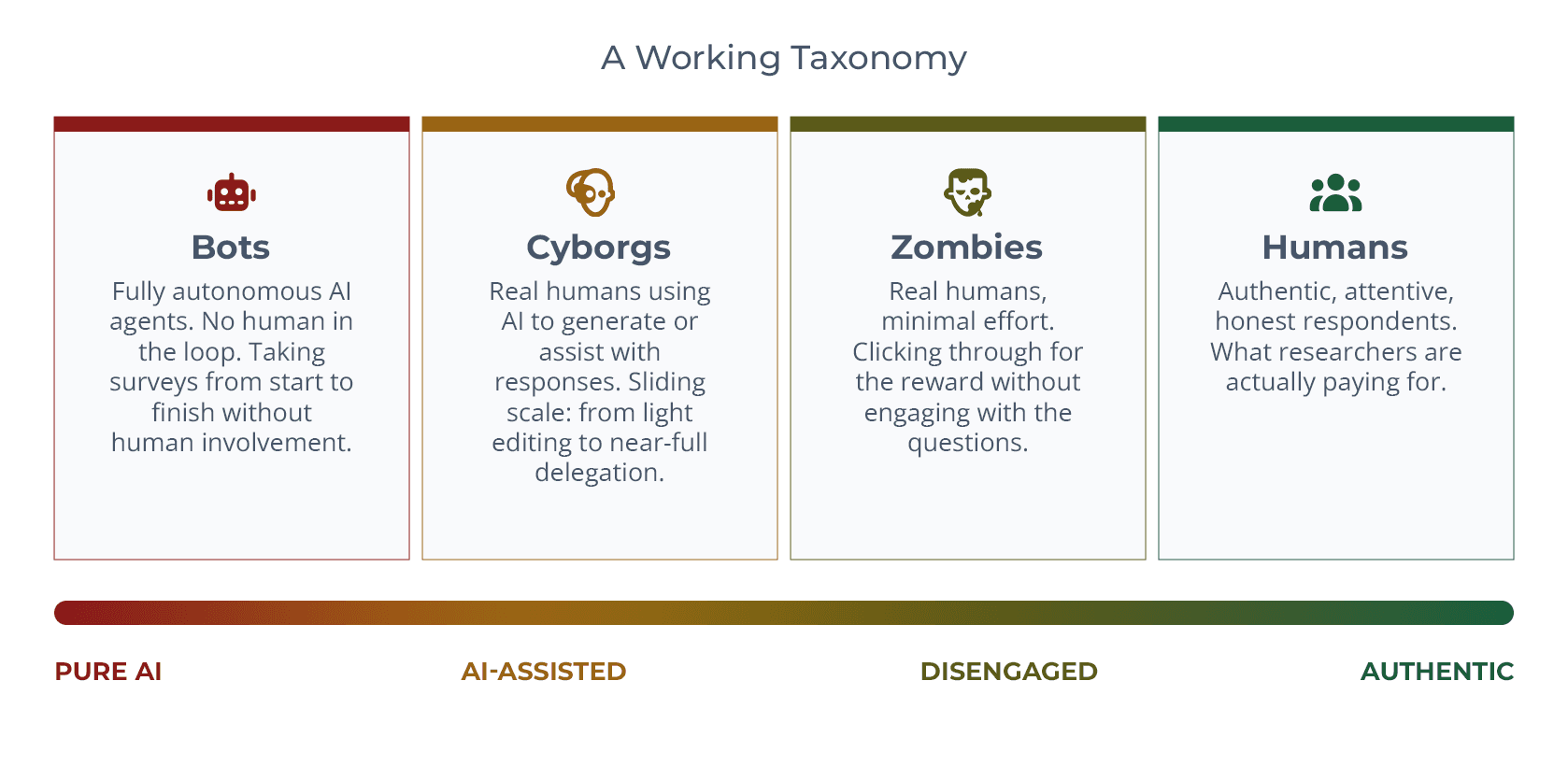
This is not a binary — it is a spectrum. And where a respondent falls on that spectrum has significant implications for how you detect them, what you do about them, and what their responses are ultimately worth.
Why the distinction matters
A Bot and a Zombie require entirely different responses. A Bot is a technical problem: it can be detected today through behavioral signals — mouse movements, keystroke patterns, timing, browser fingerprinting — because automated agents interact with interfaces in ways that are systematically different from humans, no matter how sophisticated they become. The solution is better detection infrastructure.
A Zombie is a human problem: it requires better survey design, smarter screening, more meaningful engagement, and platforms that vet participants for attentiveness before they ever reach a researcher’s study. Detection alone doesn’t solve it. You can perfectly identify a Zombie and still not understand why they’re disengaged or how to replace them with someone who isn’t.
A Cyborg is the most nuanced of the three — and the most commonly mislabeled. Consider the student who submitted a homework assignment containing text that had been hidden in the assignment instructions, text only visible to AI processing the document. She didn’t copy the whole thing. She used the AI’s output selectively — taking what seemed useful and setting aside what didn’t apply. That is not a bot. That is a person who has incorporated AI into her workflow in a way that raises legitimate questions about the authenticity of her output. But treating her the same way you’d treat an autonomous agent, or a disengaged clicker, misunderstands what happened and what actually needs to change.
What today’s data really shows
The chart below shows what rigorous separation between human respondents and autonomous bots looks like in survey research today. (Full methodology here.)
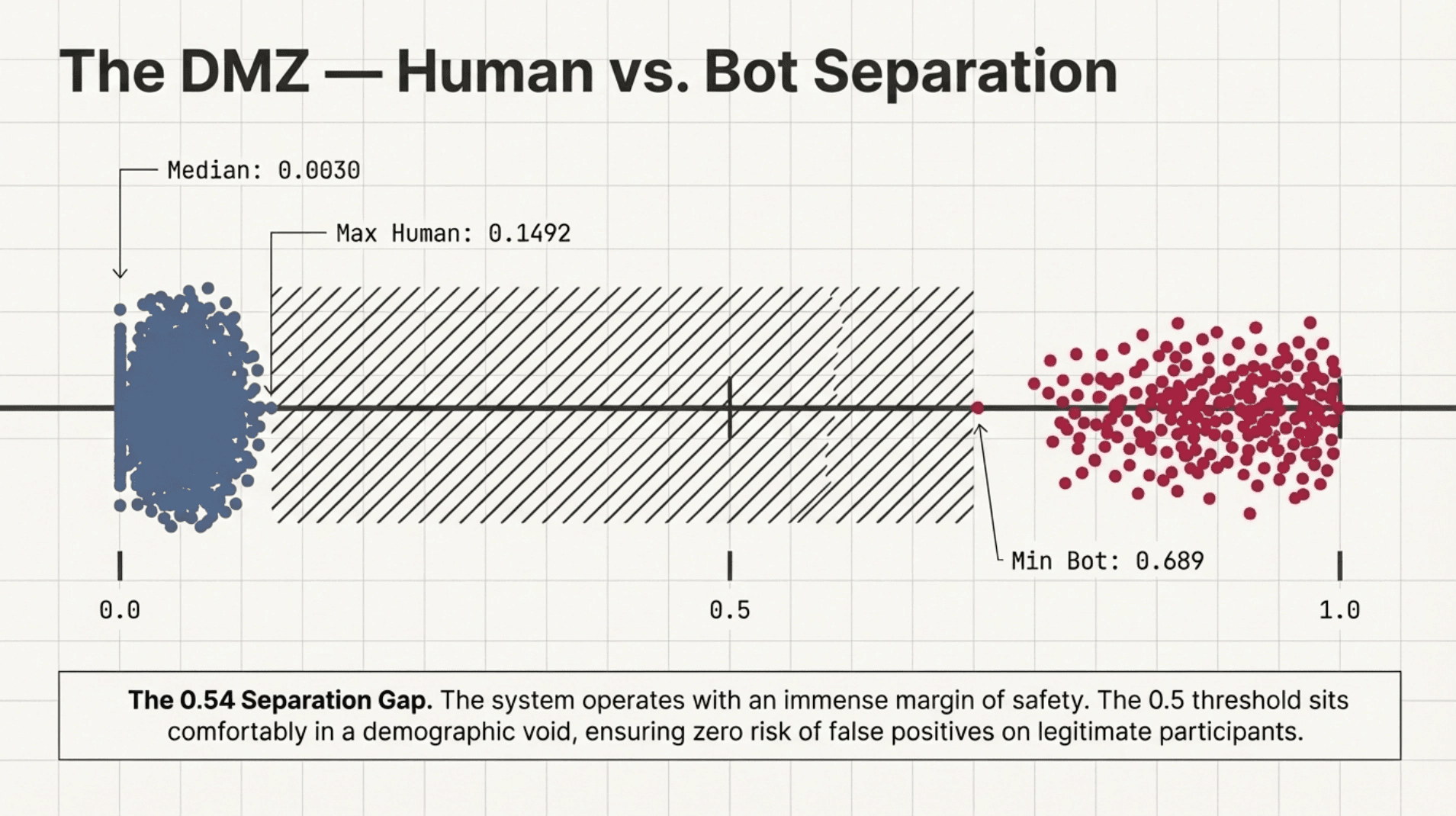
Human respondents (blue) cluster near 0. Autonomous bots (red) cluster near 1.0. Between them: a 0.54 separation gap — a demographic void where neither population lives. The 0.5 detection threshold sits comfortably in dead space with zero false positives in either direction.
That clean separation is the good news. The more instructive finding is what happens when you introduce Cyborgs and Zombies into the picture. They don’t cluster cleanly with the humans or with the bots. They begin to drift into the DMZ — the hatched zone between the two populations. Not across it, not yet. But the void that once contained nobody is starting to fill from the middle. That is not a bot problem — that is a taxonomy problem. You cannot build the right defenses against a threat you haven’t correctly named.
Fully autonomous agents that can navigate a well-designed conversational survey from start to finish remain relatively rare today. The ones we see require significant engineering effort and substantial prompt-coaching to execute. That will change — costs fall, capabilities improve. But the industry’s response to that future needs to be grounded in an accurate understanding of the present. Right now, most bots, well, are not.
A call for more precise language
We are not proposing this taxonomy as the final word. We are proposing it as a starting point for a conversation the industry needs to have. Words shape thinking. If researchers, platforms, and press keep reaching for “bot” as a shorthand for any data quality anomaly, we will keep building solutions calibrated to the wrong problem.
A Bot requires better detection infrastructure. A Zombie requires better screening and engagement. A Cyborg requires rethinking what authenticity means in a world where AI assistance is ubiquitous. These are three different problems. They deserve three different names — and three different responses. Naming them correctly is the first act of solving them.
Jonathan Robinson is co-CEO and CTO of CloudResearch.
Thanks to Leib, Aaron, Josh, Meirah, and Israel for the data and the debates that sharpened this thinking.