A Front Row Seat to the Data Quality Crisis in Online Research

In this post:
- How the 2018 “bot scare” on MTurk turned out to be something stranger and what video interviews with actual fraudsters revealed about who’s really filling out surveys
- Why roughly 40% of online survey responses are unusable, and how that bad data has produced viral findings about everything from bleach-drinking to political violence
- How a sprawling global ecosystem of click farms, account renters, and influencer-led “fraud courses” exploits the platforms researchers depend on
The Bot Scare
I started at CloudResearch in the summer of 2018. My dissertation was almost finished, and I was eager to move on. I left New Orleans in May and began work in July.
For the first few months, I commuted between Albany, where my wife and I had an apartment, and New York City, where the office was located. During the week, I sublet a place in Queens. Then, I rode the train home or to Connecticut for the weekend, where my in-laws lived. Everything was new, and everything was exciting.
As I put the worries of graduate school behind me, I threw myself into finding a place within the company. I was hired as a project manager, someone to help clients run studies and learn about the platform. Research was pitched as a side opportunity, something to pursue if there was time. One month in, a crisis created the time.
It started with a post on social media. Someone reported a problem with his MTurk data (from Amazon’s Mechanical Turk) and asked if others were having similar problems. They were.
Overnight, researchers started finding random responses to multiple choice questions, gibberish written responses, and a suspicious pattern where multiple participants seemed to be submitting surveys from impossible locations—a statue in Buffalo, a lake in Kansas. People also reported struggling to find correlations and other effects that should have been obvious. One person even reported that his participants expressed warmth toward Nazis and Ku Klux Klansmen. Nothing made sense.
Although the plunge in data quality affected everyone—one out of every two studies published in top psychology journals at the time used MTurk data—it affected me for two reasons. I had just started at a company with seven employees; that company’s only product helped people gather data from MTurk.
Two days after the first report, I wrote a blog. In it, company co-CEO Leib Litman and I examined how often participants had submitted surveys from the same location across 100,000 previous studies. The rate had recently increased. So, we confirmed what others had suspected: location was associated with bad data. What no one knew was why.
A few weeks later, someone suggested an answer: bots. Summarizing conversations online, Wired and The New Scientist published articles claiming that automation was driving the decline in data quality and “ruining social science studies.” The theory made some sense. A sudden and massive drop in data quality that was tied to specific locations could be caused by bots. But the evidence was thin.
An alternative explanation, favored by the CloudResearch team, was that the problem came from people. We knew there were a lot of Indians on MTurk and a smattering of people from other countries where English was not the primary language. Our tech team also thought it was unlikely, though not impossible, that someone with the skill to program a bot would put that knowledge to work scamming researchers on MTurk.
To test the competing explanations, we conducted a study. The design of our study was simple.
We knew the worst data came from participants using virtual private networks to mask their location. We grouped about sixty of these locations together and labeled the people using them as ‘farmers’—because they used server farms to hide their location. We grouped everyone else into what we elegantly labeled ‘non-farmers’—the city folk of online surveys. Then, we compiled measures of data quality and gave them to both groups.
People using server farms provided bad data; everyone else provided good data. This was true across every measure we examined: scale reliability estimates, individual response consistency, experimental replications, and open-ended responses. We also found that everyone passed our bot detection measures—no one failed a Captcha, no one failed a honeypot. Then there were the questions of cultural knowledge.
Because we believed that people using server farms were outside of the US, we created multiple measures that assessed familiarity with US cultural conventions. One measure showed people the vegetable in Figure 1, and asked: what do you call this object? In the US, people call it an eggplant. In India and other parts of the world, it is a brinjal or aubergine. Almost all the farmers failed these cultural checks, while nearly all non-farmers passed them.

Once we had the data, we raced to tell the story. I remember sitting in what I’m now sure was an illegally run AirBnB in Queens writing up the results. When we published a blog on September 18th, we titled it “After the Bot Scare: Understanding What’s Been Happening With Data Collection on MTurk and How to Stop It.”
Within hours, we knew we had met the moment. People started sharing our blog on social media and posting comments. We received hundreds of emails. Everyone, it seemed, was fascinated by our story of fraud. Within a few months, our blog received hundreds of thousands of views, to my surprise. One day I was a graduate student, working on papers that would receive modest attention and hopefully a few journal citations. The next day, I had contributed to something that influenced people far beyond my discipline. It was the same work, I was the same person, but the impact was far greater.
With time, I came to see the ‘bot crisis’ as part of an important realization. Thanks to my position at CloudResearch, I had a front row seat to the data quality crisis in online research. It’s a seat I haven’t given up for the past eight years.
What Online Survey Fraud Looks Like
Since the bot scare, I’ve nursed an interest in fraud that is made possible by the internet.
Some of these scams are well-known: fake investment schemes, supposed romantic interests, ransomware attacks, crypto thefts. Although some of these techniques have been around long enough to seem innocuous, each year they succeed in separating people from their life savings. In addition, most people underappreciate the scale and complexity of online fraud. For example, the U.S. Treasury Department estimated that Americans lost $16.6 billion to online scams in 2024, and some ransomware attacks have become so successful that their proprietors invest in customer support. That’s like the mob running a help line.
Thanks to journalists, we know much of the industrial scale fraud—what we might call the factories of online fraud—originates in war-torn countries like Myanmar. Sometimes, these operations rely on forced labor, revealing a truly ugly side of human behavior. Yet, next to these industrial operations, there exists a sprawling ecosystem of smaller schemes that most people know nothing about. These operations exploit any system that pays people for engagement.
Take online music as an example. Streaming services have made it easy for people to listen to nearly any music they want and just as easy for musicians to post songs. Behind the curtain, however, there is fraud. Scammers post white noise tracks and direct bots or click farms to “listen,” collecting ad revenue. In other cases, they steal music from amateur musicians and pass it off as their own, collecting royalties from streaming services.
While music is something to enjoy while you’re alive, even death presents an opportunity for fraud. In recent years, “obituary pirates” have taken to scouring newspapers and websites for details about the death of strangers. Then, they use AI to create lengthy tributes, post videos on YouTube, or invent stories about the person’s death. In each case, the goal is the same: create clickbait, harvest web traffic, earn money from ads. As a psychologist, all of this is fascinating, if a bit disheartening.
Next this petty fraud, you can add survey research. Marketers, academics, and other researchers have always had more demand for data than people willing to give it. Because research platforms operate on a voluntary basis, anyone willing to take surveys can earn as much as they want.
During the bot scare, my team revealed that the data on MTurk came from people using server farms to mask their locations, and that these people were often outside of the US. Even though most researchers accepted this story, they continued to refer to the problem as a “bot” problem. This shorthand caused confusion when lots of new researchers turned to online platforms for the first time during the COVID-19 pandemic.
To cut through the confusion, my team started inviting participants who had provided years’ worth of suspect data to participate in video interviews. By interviewing people, we hoped to: 1) clearly demonstrate that data quality problems came from people instead of bots, and 2) learn about the tools and techniques people used to evade detection. We wound up with a lot more than that.
I was the first person to conduct these interviews. As I sat on Zoom, waiting for someone to appear, I felt nervous and exposed. ‘Who was going to join the call? What were we going to talk about? Would they be suspicious of me? What risk was there in providing details about myself?’ It turns out, I had little reason to worry.
When someone appeared on camera, I saw a room like that in Figure 2. There were multiple men, lots of computers, and dingy lighting. While I went into the call expecting to have a conversation, it was immediately clear no one in the room spoke English well enough to converse. So, we relied on chat.

During the chat, I realized these guys had no interest in me. They had been offered $25 to participate in a video call and all they wanted was to earn the money. I also grew convinced that they were not in the US. While their lack of English was one sign, the conversation between themselves was another. After having the call translated, I learned that the two men talked about surveys while they worked, asked each other about some of the tools they used, and even made a joke at my expense. Apparently, they weren’t as interested in our cross-cultural exchange as I was.
After talking with my team, I launched another interview the next day. Despite making sure to exclude the participant from the day before, who did I see when someone appeared on screen? The same guys from the day before! They waved, sort of laughed, and went through the motions of answering my questions.
The CloudResearch team eventually conducted hundreds of interviews and the more people we interviewed the more we learned. Many people we spoke to operated on their own, taking surveys for cash. Other people were part of an operation that coordinated their efforts and took studies across multiple platforms. Some participants tried to hide who they were, dodging questions about their location or claiming to be somewhere they clearly weren’t. More than one person told us their favorite thing to do in New York was visit the Grand Canyon. Other people were surprisingly candid. One person explained, matter-of-factly, that they lived in a household where multiple family members shared the same account. To them, there was nothing illicit about it. They were just taking surveys online.
We interviewed people from all over the world. While many people on MTurk came from India, Sri Lanka, and Bangladesh, our interviews with participants on other platforms turned up people from Nigeria, Venezuela, Russia, China, and various places in the Caribbean. Regardless of where these people were from, we saw a consistent pattern in their behavior. Largely due to language issues, people had a tendency to say ‘yes’ to survey questions. Even when we asked them about impossible things or made up fake answer choices, they often said ‘yes’ to our questions.
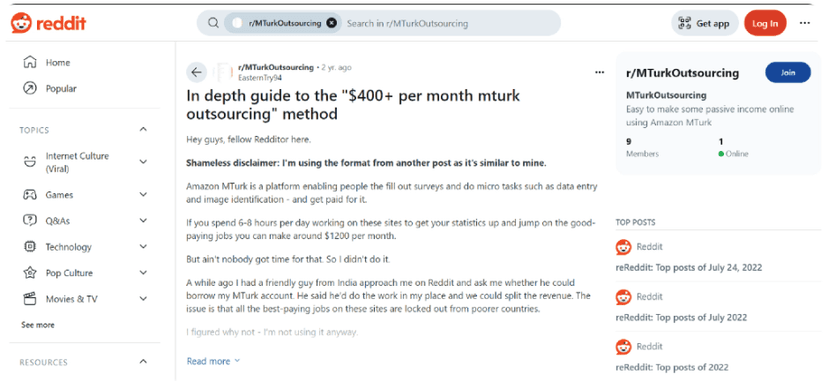
The other thing we learned was how participants found survey websites. Most of it happened on social media. We found posts where people shared information about how to create an account and avoid detection. Other posts described how people in the US “rented” their accounts to people outside of the US (Figure 3). And, we found a cottage industry of influencers (see this recent YouTube video). Some people not only make money from taking surveys, but they also turn around and “sell” their expertise to followers on social media. One man we learned about ran a “professional development” course people could pay to attend.
Once we started looking, the fraud was everywhere. The question then became: how much fraud is there?
How Much Survey Fraud Exists?
Years after the bot scare and well into our series of video interviews, it was unclear how much fraud existed online. Different studies produced different estimates. What everyone lacked was good, systematic data that examined an entire platform or dozens of platforms simultaneously. So, my team set out to gather that data.
After the bot scare, CloudResearch began vetting participants on MTurk and separating them into a group of approved participants researchers could use to run studies and another group that was blocked from all studies run through our system. After vetting a couple hundred thousand people, we had one of the best views of data quality available, and we set out to write a paper.
In the paper, we compared data quality among different groups of MTurk participants as a way to validate our approach to screening. We also reported that among the 165,000 or so participants we had vetted, 65,000 provided junk data. That is 39 percent. Interestingly, this number appeared in other places as well.
Thanks to a group called Case for Quality, market researchers set out to examine how much fraud existed in commonly used platforms for industry research. After gathering data from four of the most commonly used platforms, they reported that about 40% of participants were excluded for inattention or fraud (Figure 4).
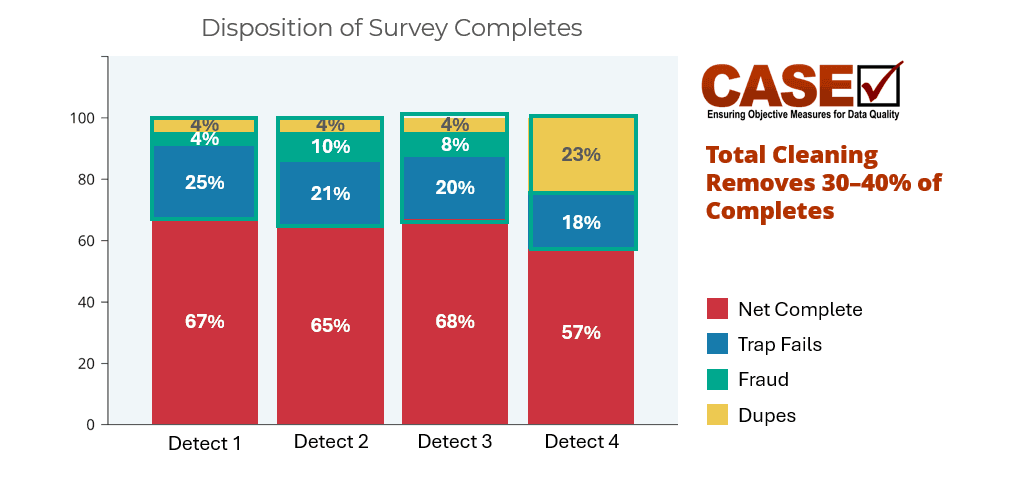
The consistency was hard to ignore. Different platforms, different methods, fundamentally different populations and the percentage of fraud landed in the same place: around 40 percent.
Forty percent fraud means that in the average study, if you gathered data from 1,000 participants with no quality controls, you could expect four hundred to provide unusable data. While it might seem like no one would ever make the mistake of taking such data at face value, we found many examples of fraudulent data misleading researchers.
Perhaps one of the biggest mistakes we found was tied to the COVID-19 pandemic. Near the start of the pandemic, the Centers for Disease Control and Prevention (CDC) published a report claiming that 40% of US adults were using cleaning products in dangerous ways to avoid infection, including 4% who reported drinking or gargling bleach or other household cleaners. This finding made international headlines, piggybacking on some infamous remarks made by the President, and fueled concerns about public health literacy.
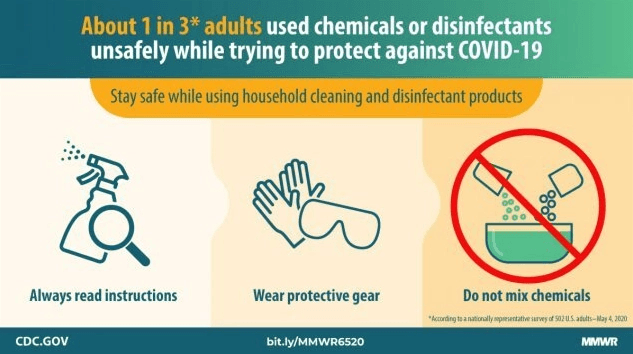
But when CloudResearch re-ran the study with proper quality controls, we found something very different. The most dangerous behaviors, like drinking bleach, were reported exclusively by participants who failed attention checks. When we asked people to describe their experience of drinking bleach, no one provided a credible account. What they did provide were responses that revealed how they had misunderstood the question or failed to pay enough attention.
Unfortunately, the mistakes in the CDC study weren’t a one off; we discovered other high-profile findings that followed the same pattern.
For instance, in the last five years or so, all these stories have received widespread media attention:
- 30% of Millennials doubt the Earth is round
- 20% of Millennials believe the Holocaust is a myth
- 50% of African Americans don’t think it’s okay to be White
- 20% of people support political violence
- 18-24 year olds are returning to church
And all of them have turned out to be wrong, inflated by bad data (see here, here, and here). In each case, the problem was that researchers either relied on poor measures of data quality or trusted that the panel they used to recruit participants was doing enough to root out fraud.
So, this is where data quality in online research stood throughout my first seven years or so at CloudResearch. We had documented the scale of the problem. We had interviewed the people behind it. We had traced the ecosystem from click farms to people renting accounts and teaching courses on how to scam surveys. And we had seen what happened when bad data slipped through.
For a few years, we made progress. CloudResearch built tools to detect VPNs, flag inconsistent responses, and catch duplicate accounts. The fraud didn’t disappear, but it became manageable. We learned how to stay a step ahead.
Then came artificial intelligence.
In Part 2 of this Chapter 10 blog, I will explain how AI is reshaping the data quality crisis: both as a threat that undermines our best defenses and as a tool for fighting back.
This post is part of a series exploring the chapters of Research in the Cloud: A Hands-On Guide to Behavioral Research in the Digital Age by Aaron Moss, Jonathan Robinson, and Leib Litman. Read Chapter 10 here.