Blog
De-Scaling Quantitative Research: Why Fewer Respondents Could Mean Better Data

For decades, quantitative research has operated under a straightforward assumption: more respondents produce better data. That belief has driven the industry’s focus on scale and ever-larger sample sizes. But as we reckon with the data quality crisis that approach has inadvertently created, the assumption is beginning to unravel.
Fraud is one of the most visible consequences of research at scale. In large-scale quantitative studies, fraud rates average 20%, meaning one in five responses may be distorting findings. Survey fatigue compounds the problem: attention and response quality decline after the 15-minute mark, while response rates have steadily fallen for decades. Fixed-format surveys, the backbone of traditional quant research, capture what respondents select but offer little insight into what they actually think.
The industry has accepted these issues as the costs of doing business at scale. But AI advancements are making a different approach possible: one that asks fewer people, extracts more from each one, and uses AI to make every response count.
The Downside of Prioritizing Volume
In addition to fraud, disengagement, and survey fatigue, low incentives compound these issues. When respondents are asked to invest time and effort without fair compensation, the pool of willing participants narrows. Those who do participate are no longer representative of the population as a whole.
The current industry conversation has largely focused on two responses: scaling qualitative research using AI to conduct conversational interviews simultaneously, or using synthetic respondents to fill volume gaps. Nearly three-quarters of market researchers agree that synthetic responses will account for the majority of research within three years. Both are legitimate tools, but neither addresses whether the end-to-end research process itself needs to be redesigned.
A Smarter Framework for Research
Frank Kelly, Market Research Practice Lead at Virtual Incentives, has been developing a framework he calls “Evolutionary Surveying.” It treats research not as a single large study, but as a continuous process that moves from deep qualitative exploration toward quantified insight.
“We have the tools now to do fully iterative research that starts at the very beginning and ends with a quantified result. It’s not just a discussion about a tool that connects qual and quant; it’s redesigning the whole research process.”
— Frank Kelly, Market Research Practice Lead, Virtual Incentives
At CloudResearch, we’re seeing this kind of iterative approach play out directly with clients using our Engage conversational AI interview platform. Reuben Paris, who works closely with Engage users, describes how research workflows are already evolving:
“Some clients use Engage primarily for exploratory qualitative research, while others take a more iterative approach. In those cases, findings from an initial wave of conversational interviews are analyzed and used to refine the research instrument within hours. The updated study is then fielded to a larger audience the next day. In some projects, this process ultimately leads to a large-scale quantitative study. In others, the goal is to build a rich data asset that can be used to create and query synthetic personas. The common thread is that research is no longer a single event — it evolves through successive cycles of learning, refinement, and scale.”
— Reuben Paris, CloudResearch
But this raises an important question: can smaller samples produce credible results?
One answer comes from Planned Missing Data Design (PMDD), a well-established methodology in social science research. It shows that data collected in modular subsets can be statistically connected and completed, producing valid findings without large respondent pools. This is the academic foundation that makes iterative, lower-volume research statistically credible.
The Five Stages of Evolutionary Surveying
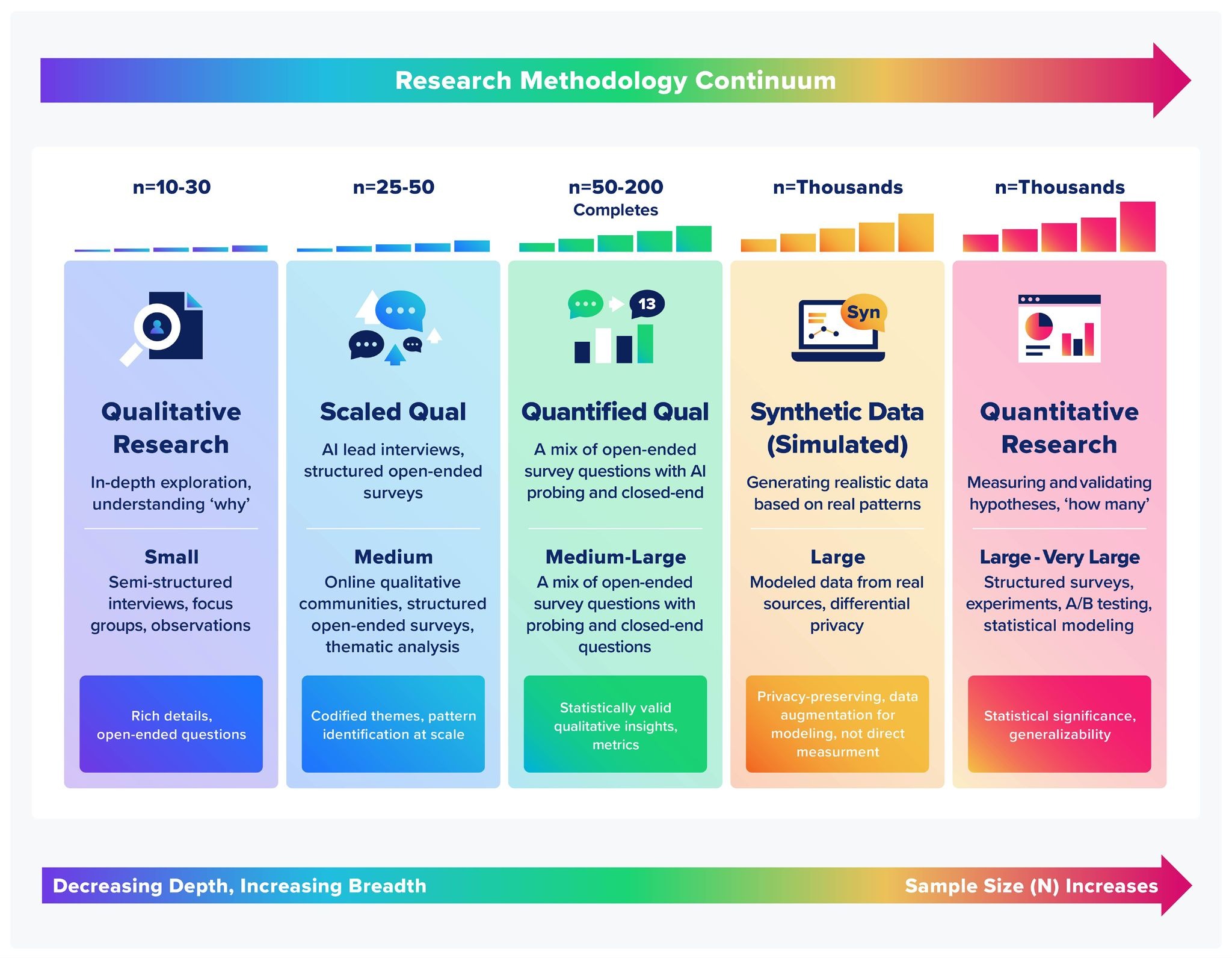
Virtual Incentives’ Evolutionary Surveying framework outlines a research methodology continuum with five stages:
- Qualitative Research: Human-to-human in-depth interviews. Rich, open-ended exploration to understand the “why” behind a question.
- Scaled Qual: AI-led interviews replace human moderators, enabling structured open-ended surveys at speed while surfacing recurring themes and patterns.
- Quantified Qual: A mix of closed-ended and open-ended questions with AI probing that produces statistically valid qualitative insights.
- Synthetic Data: Modeled data drawn from patterns across multiple studies. Privacy-preserving and useful for filling gaps without additional fieldwork.
- Quantitative Research: Structured surveys, A/B testing, and statistical modeling for hypothesis validation at scale.
The framework is designed with flexibility. Some questions will move through stages 1 through 3, while others will progress through stages 1 through 4 or jump directly from stage 3 to stage 5, depending on the research need.
How AI Powers the Framework
The framework’s flexibility comes from how AI operates at each stage of the process.
Traditional fixed-format surveys give respondents a list of options to choose from but provide little insight into why they made those selections. AI-moderated conversational surveys work differently. The tool adapts based on participant responses, asking follow-up questions and adjusting future questions based on prior answers. A 2025 study found that AI-powered conversational surveys improve participant engagement and response quality compared to static formats.
That adaptability extends beyond individual interviews to the framework as a whole. Frank Kelly describes this as “Adaptable Research Design”: as patterns emerge, the survey evolves. Questions that have been answered shift into structured formats, and probing goes deeper where understanding remains thin.
AI integration also strengthens fraud prevention. Early-stage AI-moderated audio or video interviews are much harder to fake than traditional surveys. AI can verify that a respondent speaks the native language, matches their profile, and provides authentic responses. Suspicious behavior can be flagged or the session terminated in real time.
This is where CloudResearch’s infrastructure plays a direct role. Our Sentry fraud detection layer works in concert with AI moderation throughout data integrity at every stage of data collection, catching bad actors at the point of entry rather than after the damage is done.
Why Incentive Design Is a Data Quality Decision
Better research design only works if participants are willing to provide thoughtful responses. That requires examining how incentives are structured.
Survey compensation has not kept pace with rising participant expectations, while demands on participants have increased. Longer sessions, identity verification, video participation, and conversational AI interviews require more cognitive effort and trust. When incentives are too low, participation drops and bias enters the data from the start.
Consider who produces richer data: a motivated, fairly compensated participant in a short conversational session, or a fatigued respondent clicking through a 30-minute survey for a minimal reward? Fair compensation and a better participant experience produce better data.
A practical starting point: offer variable incentive strategy that matches the type of participation. Video sessions warrant higher compensation than voice sessions, and voice sessions more than text. Deeper, open-ended early-stage interviews should carry stronger incentives than the structured questions that follow. Virtual Incentives’ platform is designed to help research teams operationalize this kind of variable, stage-appropriate compensation.
Smarter incentives produce richer sessions. Paired with AI probing, they create the depth needed to support smaller, statistically viable research designs.
What This Means for Research Teams
The shift toward iterative, AI-moderated research changes not only methodology but how researchers work. The traditional model was largely logistical: design the study, send it to the field, wait for data, analyze. The researcher’s role was defined by discrete handoffs between separate functions.
The iterative model changes that role from project management to directing the research process. Insights arrive continuously, and the instrument evolves based on learnings. Decisions about when to move to the next phase, or when a research question has been sufficiently answered, stay with the researcher. For research teams, this means building processes that support continuous learning rather than one-and-done data collection.
CloudResearch’s suite of tools: Engage for conversational AI interviewing, Connect for participant recruitment, and Sentry for fraud detection, is designed to support researchers at every stage of this continuum.
Ready to Explore a Smarter Research Workflow?
Whether you’re running a single exploratory study or designing a multi-stage research program, CloudResearch can help you get better data from fewer respondents without sacrificing statistical rigor. Talk to our team to see how iterative, AI-moderated research works in practice.
FAQs
What is Evolutionary Surveying in market research?
Evolutionary Surveying, a framework developed by Frank Kelly at Virtual Incentives, is an iterative approach to research design in which the data-collection instrument adapts based on learnings from each stage. Rather than deploying a fixed survey to a large sample, researchers move through progressive phases, adjusting the design as understanding develops.
How does AI improve the quality of survey data?
AI-moderated conversational surveys use adaptive probing to elicit richer, more thoughtful responses. Early-stage video and audio validation flags fraudulent or disengaged participation before it contaminates the data, a capability that integrates directly with CloudResearch’s Sentry fraud detection layer.
Why does sample size matter less when using AI-moderated interviews?
Traditional quant research relies on large sample sizes to compensate for individual-response variability and fraud. When AI moderation improves data quality and validates participant authenticity, fewer respondents are needed to reach confident conclusions.
How should survey incentives be structured for conversational research?
Incentives should reflect the level of effort, time, and intrusiveness of a study. Variable incentive structures align compensation with participant effort, attracting more motivated, qualified respondents. Smaller incentivized samples can match or outperform larger, under-incentivized ones.
Further Reading
To learn more about this topic, check out Virtual Incentives’ blog: https://www.virtualincentives.com/de-scaling-quantitative-research-why-fewer-respondents-could-mean-better-data/.