

Watch the Story
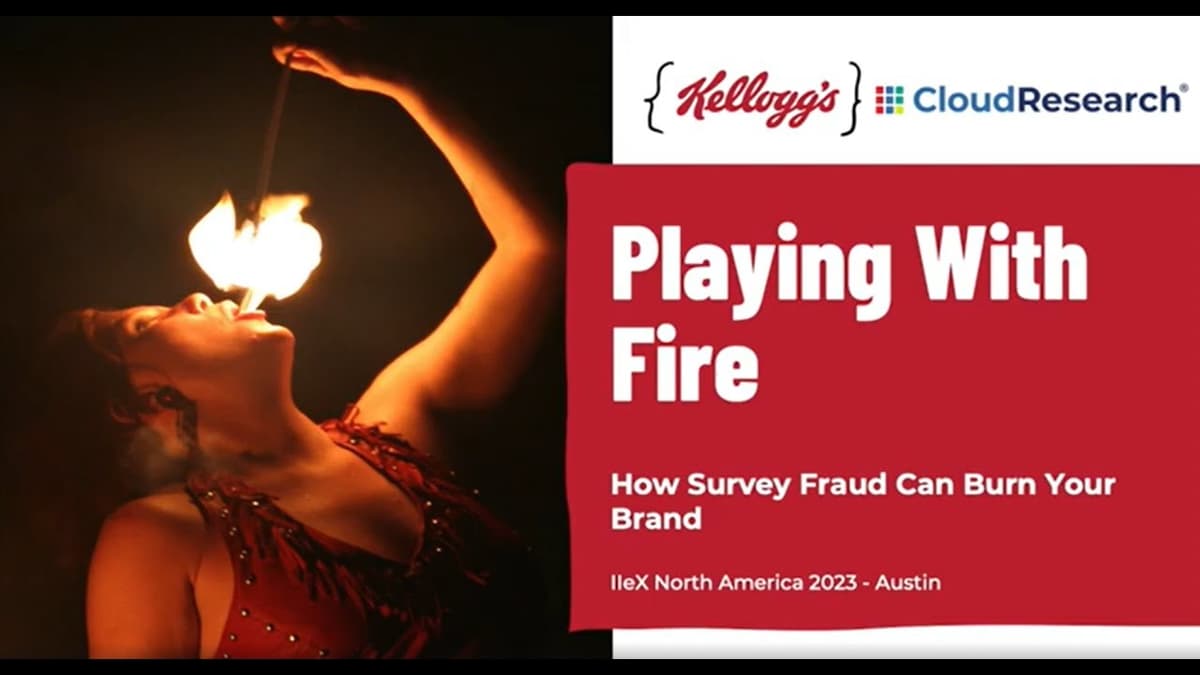
At IIEX, the CloudResearch and Kellogg's teams took the stage to tell this story firsthand — how a fraud-riddled sample nearly steered a campaign the wrong way, and how Sentry caught what previous providers missed. Watch the full 24-minute presentation, then read how it played out below.
The Challenge
Kellogg's relies on consumer survey data to steer brand and campaign decisions. So when the marketing team had a promising creative concept on the table, built around "fire eaters," for an upcoming ad, a complication surfaced by a routine Google search carried real weight: the term also carries a dark historical association with a pro-slavery faction from the antebellum South. Before moving forward, the team needed to know how consumers would actually react.
The stakes went beyond a single ad. A large share of the responses feeding Kellogg's brand decisions was fraudulent: bots, professional survey-takers, and inattentive "yes-man" respondents who reflexively affirm whatever they think researchers want to hear, blending invisibly into data that previous providers missed entirely. Undetected, that fraud doesn't just add noise, it points campaigns in the wrong direction, the kind of bad data that can burn a brand.
The Solution
To better understand consumer reactions, the team designed a 450-person study comparing sentiment toward "fire eaters" against neutral terms like "fire dancers," measuring how feelings shifted before and after respondents learned the term's history. Given what was riding on getting a true read, Kellogg's partnered with CloudResearch to screen the study through Sentry, layering device- and behavior-level validation on top of the standard cleaning most providers rely on.
Device-Level Screening
Sentry's first pass flagged 13% of the sample at the device level: bots and duplicate participants that basic cleaning tools typically catch, but which still make it through in industry-wide fraud rates as high as 40%.
Behavioral Pattern Detection
The larger catch came from behavior: 40% of the sample was flagged for patterns like yea-saying, surfaced by mixing in validated questions from large libraries so that fraudulent respondents couldn't learn and repeat an answer key.
Isolating the Real Signal
With both layers applied, Kellogg's could finally see how real consumers felt about the concept, separating genuine sentiment from the inflated positivity that fraudulent respondents were feeding into the results.
Results
Based on standard sample-provider cleaning, Kellogg's would have concluded that most consumers felt positive to neutral about the "fire eaters" concept. Sentry's cleaned data told a different story entirely.
Fraudulent respondents alone reported 54% positivity - nearly the inverse of genuine sentiment.
The Danger of a "Yes" Man
- Reported awareness of the term's historical association dropped from 34% to 11% once fraudulent respondents were removed. Most of the "awareness" in the raw data wasn't even real
- Positive sentiment fell by half, from 34% in the uncleaned sample to 17% in the cleaned one
- Fraudulent respondents alone reported 54% positivity, nearly the inverse of genuine sentiment
Protecting the Launch Decision
- Cleaned data showed post-reveal negative sentiment outweighing the positive, a risk level too high to move forward as planned
- Disaster averted: the campaign's real exposure was invisible in the uncleaned numbers
- These results confirmed that fraud detection needs to look beyond device fails and duplicates to catch positivity bias
What's Next
The study became a cautionary example for Kellogg's teams, underscoring that fraud isn't just noise: left unchecked, it can flip a decision entirely. Kellogg's continues to rely on CloudResearch for verified participants across its consumer research.
About Kellogg's
Kellogg's is one of the world's most recognizable food brands, with a portfolio of cereals and snacks sold in markets around the globe. Consumer insight sits at the center of how the company develops products and campaigns, making survey data quality a direct input to brand strategy.