








In this post I will share:
- My unexpected path from working construction to behavioral science
- What behavioral science is and why it matters
- What you’ll learn in Chapter 1 of Research in the Cloud
- How to access the free textbook
From Construction to College
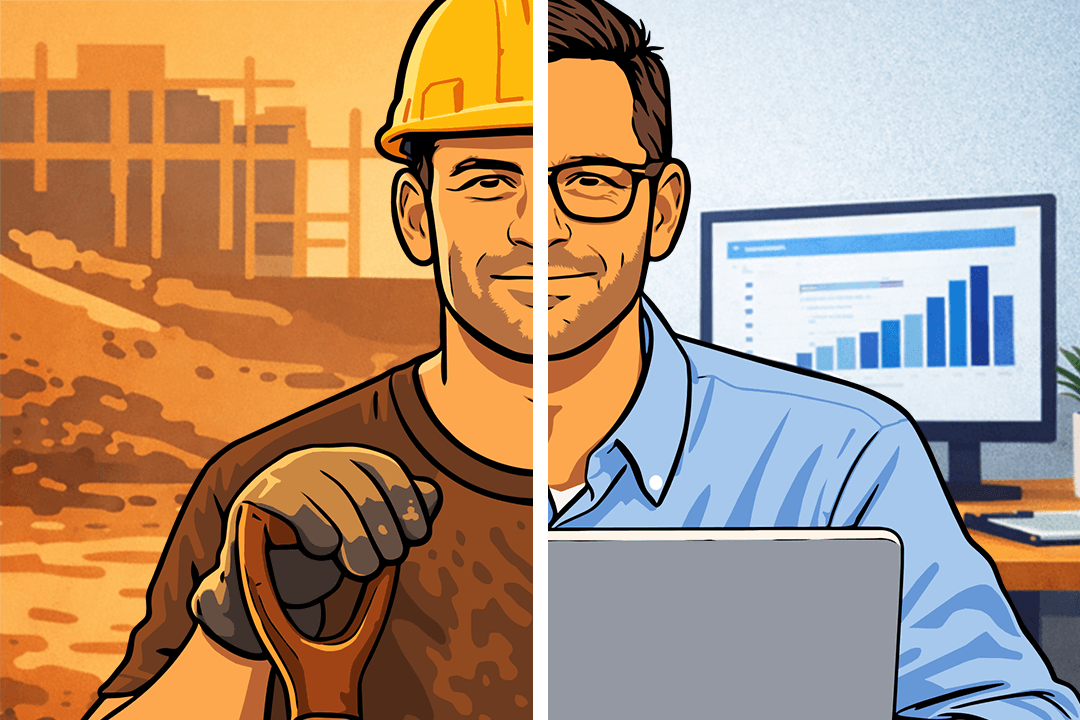
I graduated from high school in 2007 and set to work performing physical labor. Technically, I was an apprentice concrete finisher. But in reality, I was a grunt. My plan was to pour concrete for the summer and start college in the fall.
Growing up, I was more interested in sports than cars or mechanical things, and so, I had little practical knowledge. On my first day, we poured sidewalks. It had rained the night before and a puddle stood where we needed to work. Richard, the owner of the outfit, told me to get the water out of there. Eager to comply, I grabbed a bucket and started to scoop. When he returned five minutes later, I was still scooping. Shaking his head, he grabbed a shovel, dug a small trench, and watched the water drain away.
In the days that followed, I carried boards, drove stakes, shoveled dirt, sand, and gravel, and broke my back over a rake-like tool called a “concrete placer.” Eventually, I graduated to hand tools, which is why, scattered across central Indiana today are hundreds of structures my hands have touched: foundation walls, driveways, sidewalks, slabs, basement floors, garages, porches, pole barns, and patios. By summer’s end, I knew I needed a different education.
In August, I started reading textbooks two weeks before classes began. I’d decided to major in psychology, not because I knew what psychology was, but because my girlfriend’s mother told me I was a good listener. Neither of us realized that psychology was more than therapy. But looking back, her suggestion may have stirred something I didn’t realize at the time: I wanted to understand why people do what they do.
Three years earlier, as a high school sophomore, I’d nearly driven my biology teacher crazy asking about animal behavior. During the first week of class, he made an offhand comment about biology’s ability to explain behavior. I perked up. When would we cover that? The answer, it turned out, was the last week of the year, and we barely scratched the surface.
For the first year or two of college, I wandered through the major. I took introductory courses, learned about the biology of the brain and how humans develop over the lifespan. I took a course in clinical psychology and one in cognition. I enjoyed these classes. But I didn’t find the behavior I cared about understanding until my third year.
Sitting in a statistics class, I witnessed an incident of hate speech. A white man entered the class twenty minutes late, interrupted the lecture, and dropped a racial slur as he described a parking dispute. At first, I was shocked. Did he just say that? Did anyone else hear him? Why would someone act that way? After cycling through these questions in my mind, I got angry. I said, “Hey, I don’t appreciate that kind of talk. What do you think you’re doing?” I don’t remember his reply or what happened next. What I remember is how the experience made me feel. I was mad for hours.
That same semester, I was taking social psychology, where I learned that prejudice and discrimination were things scientists actually studied. Then, I found a psychology lab on campus, run by my professor, that studied the experience I’d had in statistics: what happens when people confront prejudice. I joined right away.
Studying Behavior, Scientifically
When I was a kid, no one answered the question “what do you want to be when you grow up?” with “research psychologist.” I didn’t know such a job existed. I also didn’t know that some people study things like attraction, persuasion, emotion, or the self for their entire career.
Working in a research lab showed me how science works. I learned how complex attitudes and behaviors are measured, how studies are designed, and how data is analyzed. I learned how to read scientific papers and how to think about theory. Perhaps most importantly, I learned the difference between having opinions about why people act a certain way and actually testing whether those opinions are true. By the time I graduated, I knew I wanted to pursue a PhD and that’s what led me to Tulane University where I conducted research on prejudice and discrimination and deepened my understanding of the science of human behavior.
That was more than a decade ago. Today, I work at CloudResearch, where I see behavioral science from a unique angle. Every day, researchers from dozens of fields design studies to understand human behavior. They use tools like ours to gather data and answer questions that would have been impossible only 20 years ago. Even though these researchers have different interests and experiences, what they share is a set of methods: tools for asking questions about people and finding reliable answers.
Watching this work unfold, I often appreciate something that would have made no sense to me when I was scooping water out of a puddle with a five-gallon bucket: understanding people requires a systematic approach. Back then, if you’d told me there was a science of human behavior — that people measure things like personality and prejudice, run experiments on decision-making, build theories about why we do what we do — I probably would have thought it was overkill. People aren’t that complicated. You learn about them by paying attention, by living life. Yet, the same practical wisdom Richard demonstrated on my first morning — there’s a better way to do this, if you know the method — applies to understanding human behavior too.
What Is Behavioral Science?
Behavioral science is the systematic study of how people think, feel, and act. It spans multiple disciplines — psychology, economics, sociology, political science, marketing, and more — united by a commitment to scientific methods. Rather than relying on intuition, authority, or folk wisdom, behavioral scientists use careful observation, measurement, and experimentation to understand human behavior.
The field has practical applications everywhere, from healthcare to business to government policy. Research in the Cloud teaches the methods that make this work possible.
What You Will Learn in Chapter 1
Chapter 1 of Research in the Cloud introduces the scientific study of people. Essentially, it explains the things it took me more than a decade to learn through college and graduate school.
Unlike other textbooks, Research in the Cloud was created with activities intended to show you how science works, rather than just asking you to read about it. These activities begin in Chapter 1, and they help illustrate several important concepts.
Measuring Psychological Characteristics
The first activity shows you how behavioral scientists transform abstract psychological characteristics, like personality traits, into measurable variables. You will experience this by taking a short personality test that measures the “Big Five” personality traits. After taking the test, you will add your scores to those of thousands of other students to learn how scientists make sense of measurements and data.
Moving From Observations to Theories
You’ll also learn how observations become theories and how theories are refined through continuous research.
The Big Five didn’t emerge overnight. It all started almost one hundred years ago, when researchers scoured the dictionary to find all the words that can be used to describe people. Then, countless studies were conducted to refine those items, build a theory, and evaluate whether the five factors do a good job explaining personality across cultures. The history of personality psychology demonstrates how theories are built and continuously refined.
The Diversity of Behavioral Science
After learning about how science refines its theories, you’ll explore the diversity of the behavioral sciences. Researchers work in fields as diverse as psychology, economics, and political science, and in organizations like businesses, universities, think tanks, and government agencies, putting research to work to improve people’s lives.
Scientific Thinking About Cause and Effect
Finally, the chapter ends with a discussion of the scientific way of thinking about cause and effect and how it differs from what people do in everyday life.
In everyday life, we all accept some information based on the authority of others or rely on our intuition from time to time. The scientific process is valuable precisely because it offers a way to understand the world that is based on evidence. Science, in other words, allows us to test our beliefs and challenge assumptions in a way that many other ways of gathering knowledge do not.
By the end of the chapter, you’ll start seeing the world the way behavioral scientists do: not as a collection of random behaviors, but as patterns waiting to be understood through scientific investigation. Then, Chapter 2 will introduce the tools you need to conduct those investigations.
This post introduces Research in the Cloud: An Introduction to Modern Methods in Behavioral Science by Aaron Moss, Jonathan Robinson, and Leib Litman.
Ready to learn? Read Chapter 1 of Research in the Cloud for free.